Menu Content/Inhalt
ISU Masters Programs curriculum
Core Curriculum Print E-mail
Module 1 provides a common core curriculum for both the MSS and the MSM, and is designed to:
Read more...
 
MSS Specialized Curriculum Print E-mail

MSS classes are tailored toward the technical aspects of space activities. Its Specialized Curriculum is divided over Modules 2 and 3 during which, students progressively acquire fundamental knowledge of major space-related subjects, focusing on space program development and space applications while continuing to develop teamwork. Though several classes in Module 2 run in conjunction with the MSM class, thus strengthening interdisciplinary learning, the majority of classes in Module 3 are unique to the MSS. This enables the MSS students to gain greater depth, knowledge and understanding in the technical fields.

mss_image.jpg

Read more...
 
MSM Specialized Curriculum Print E-mail

MSM classes are tailored toward management aspects of space activities. Its Specialized Curriculum is divided over Modules 2 and 3 during which, students progressively acquire fundamental knowledge of major space-related subjects, focusing on space program development and space applications while continuing to develop teamwork. Though several classes in Module 2 run in conjunction with the MSS class, thus strengthening interdisciplinary learning, the majority of classes in Module 3 are unique to the MSM. This enables the MSM students to gain greater depth, knowledge and understanding in management related fields.
msm_image.jpg

Read more...
 
Human Space Flight Specialization Print E-mail
Beginning with the academic year 2010-11, ISU students will have the opportunity to engage in a course of study as part of the MSc program that specializes in human space flight. This new specialization is offered as part of the MSc in Space Studies degree and will be realized with the introduction of a new sequence of courses to be offered in the third module of the program. MSS students may select this option at the beginning of Module 2.
ls_montage_cover_100202.jpg

Read more...
 
Personal Assignment Print E-mail

In Module 3, each student has the opportunity for an indepth look into a particular topic of interest by developing a personal assignment under the supervision of a resident faculty member. After making their selection from a list of possible topics, students are required to conduct individual research and produce a report and/or a publishable article.

 
Team Project Print E-mail
intercultural_training_masters_07.jpg

During Module 2 students are divided into two teams to carry out a literature surveys and critical reviews of the subject matter as background preparation for the main Team Project work. Drawing on this background research in Module 4, students continue working in their respective teams to collectively identify a focused topic for their main study project. Using their imagination and initiative students develop their skills to participate effectively in an international team, while working towards an innovative, focused, conceptual study, to create a professional printed report and presentation of the results. Throughout this module, students are faced with the task of organizing their teams effectively to carry out project work while learning how to reach solutions in circumstances where conflicting requirements often emerge and compromises must be made.

Team Project topics for the academic year 2009/2010 are:

• Space technologies to address the Earth's looming ocean crisis
• Space exploration on Earth: analog sites

Team Project topics for the academic year 2010/2011 are:

• Human spaceflights from the Kourou spaceport
• Space applications within the future e-Health environment

 
Internship & Individual Project Print E-mail

Each student must submit an individual project report based on work or research carried out during an internship at a host institution in Module 5. During this module, students have the opportunity to apply their knowledge and skills to contribute to an on-going activity in the space sector. Students establish their own internship opportunities in accordance with their particular interests and career goals, and with appropriate advice from ISU. During the internship, an on-site mentor is requested to supervise project work, and students maintain regular contact with their academic advisor at ISU. At the end of the internship students return to ISU for one week to submit their final written report and to present their project findings to an evaluation panel.

 
Professional Visits Print E-mail

masters_visits2.jpg

Each academic year, students have the opportunity to visit some of the major space related facilities or events in Europe. Previous visits have been made to EADS Space Transportation, EADS Astrium, Snecma Moteurs, SES GLOBAL, Alcatel, DLR, the European Space Operations Centre, the European Astronaut Centre, CNES, EUMETSAT, the Nice Observatory, The Strasbourg Observatory, the Commissariat à l’Energie Atomique, the University of Stuttgart, the Paris Air Show and the IAC Congress. Outside the official MSc curriculum, some students have had the opportunity to visit the European launch facilities in Kourou, French Guiana and space-related facilities in Russia.

The ISU Annual International Symposium also offers students the opportunity to participate in an international conference and to network with space experts and leaders from around the world.

 
Language Classes Print E-mail

Within the MSc curriculum, students are given the possibility either to improve their English language skills or to gain a basic knowledge of the French language. These classes are provided by the University of Strasbourg.

 
Cultural & Social Events Print E-mail

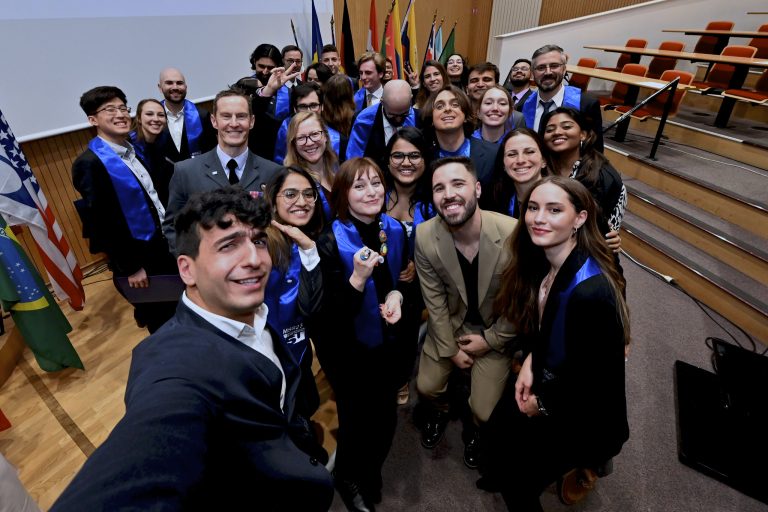
During the academic year, students are encouraged to participate in various cultural events and have the opportunity to share aspects of their own culture with others. Events include an international food tasting evening, where students are asked to prepare a small specialty from their country. Other events include introductions to certain aspects of Alsatian culture and a Year-End ISU party for students and staff in December toward the end of Module 2. Students are therefore encouraged to bring any items that they consider could be of use for these events with them.

National dress can also be worn on various occasions such as the opening ceremony and graduation.