Templeton
As an integral part of the Grant received by the John Templeton Foundation (JTF), a group of ISU MSS25 students reflected, in the framework of a Team Project (TP), on the first research question stipulated in the Grant:
How will International Cooperation in deep space exploration and space settlements evolve with the aim of finding common values among space-faring and emerging space nations, despite the current shifts and risks induced by geopolitical tensions?
The team of MSS students, composed of 14 participants and representing 11 countries presented their findings at the ISU central campus in Strasbourg on 24 June 2025 in front of the ISU faculty and online invited guests, including several members of the Ethical and Advisory Committee (EAC) overseeing the ethical aspects of the grant.
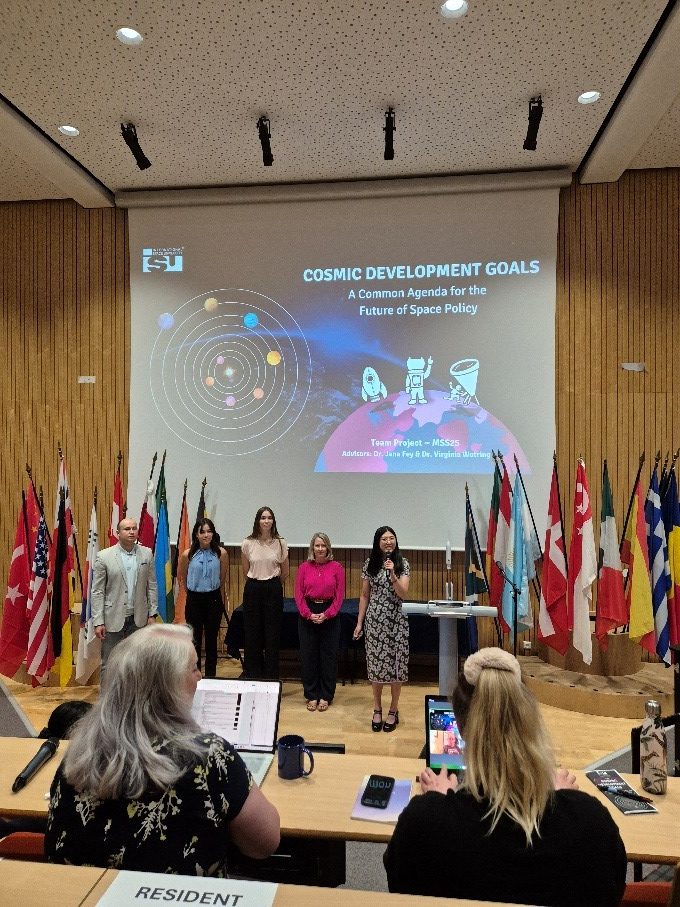
The students explained that they had first studied the existing international Treaties and regulations regarding space governance. They concluded that although several exploration aspects were covered in these treaties, most regulation ismainly concerned with space exploration by nations but were less covering the impact of commercial and private sector involvement, as we are witnessing nowadays.
The effects of such private initiatives are partially covered by different space acts, but a global and sustainable approach is lacking. Evidently, a new treaty could be a solution but has poor chances to be globally ratified under the present geopolitical circumstances.
In analogy with the now well-known United Nations’ Sustainable Development Goals (SDGs) the team, guided by Prof. Wotring and Dr. Fey, proposed a number of soft law goals, which they label as Cosmic Development Goals (CDGs) in order to create a common agenda for the future of space policy.
Similarto the principles guiding the SDGs, eight Cosmic Development Goals are proposed as follows:
CDG1 : Ensuring the health and safety of all participants and humanity in general.
CDG2 : Establishing space as a collaborative and cooperative domain to ensure international partnership, open knowledge, and inclusive capacity building.
CDG3 : Promoting responsible and sustainable space exploration by preventing contamination, regulating planetary modification, and reducing orbital debris.
CDG4 : Establishing responsible practices of space research and technology development through ethical, safe, and sustainable norms for all space actors.
CDG5 : Synergizing SHARE (Society, Heritage, Awareness, Representation and Equity) with space activities to ensure that exploration, policy, and innovation reflect our collective humanity, honor diverse legacies and actively dismantle systemic inequities.
CDG6 : Building an inclusive and resilient global space economy for the benefit of humankind.
CDG7 : Preserving the use of space for peaceful purposes.
CDG8 : Ensuring open access to space resources by preventing monopolization and enhancing responsible behavior through a milestone-based system.
Like the SDGs, the CDGs were further augmented by tangible metrics, 150 in total. The team realized that the implementation of all these goals would need a phased approach, and they therefore developed a matrix with feasible goals in periods of respectively 10/30/40 years from now.
Even if the goals are based upon the principles of ‘Good Faith’, respecting those goals could lead to increased reputation for the actors, in particular the private entrepreneurs involved in future space exploration.
Nevertheless, an oversight entity is considered as an essential tool to ensure that such type of goals is regularly updated but also monitored. The team concluded that a dedicated Working Group at the UNCOPUOS forum could be a viable candidate to conduct such a tasks.
It is interesting to note that as a follow-up of this study, a strong suggestion was made to involve all stakeholders on the basis of an effective outreach plan. This led to the proposal of the second Team Project of the Grant as a complementary research endeavor focusing on shaping a Global Communication Roadmap for space exploration (TP GCR) starting with the next students’ cohort of the 2026 ISU Masters this Fall.
A paper explaining the CDG principles in more detail is accepted for the next IAC meeting in Sydney, whereas the detailed report, as other TP reports, will be available via the ISU Library.